
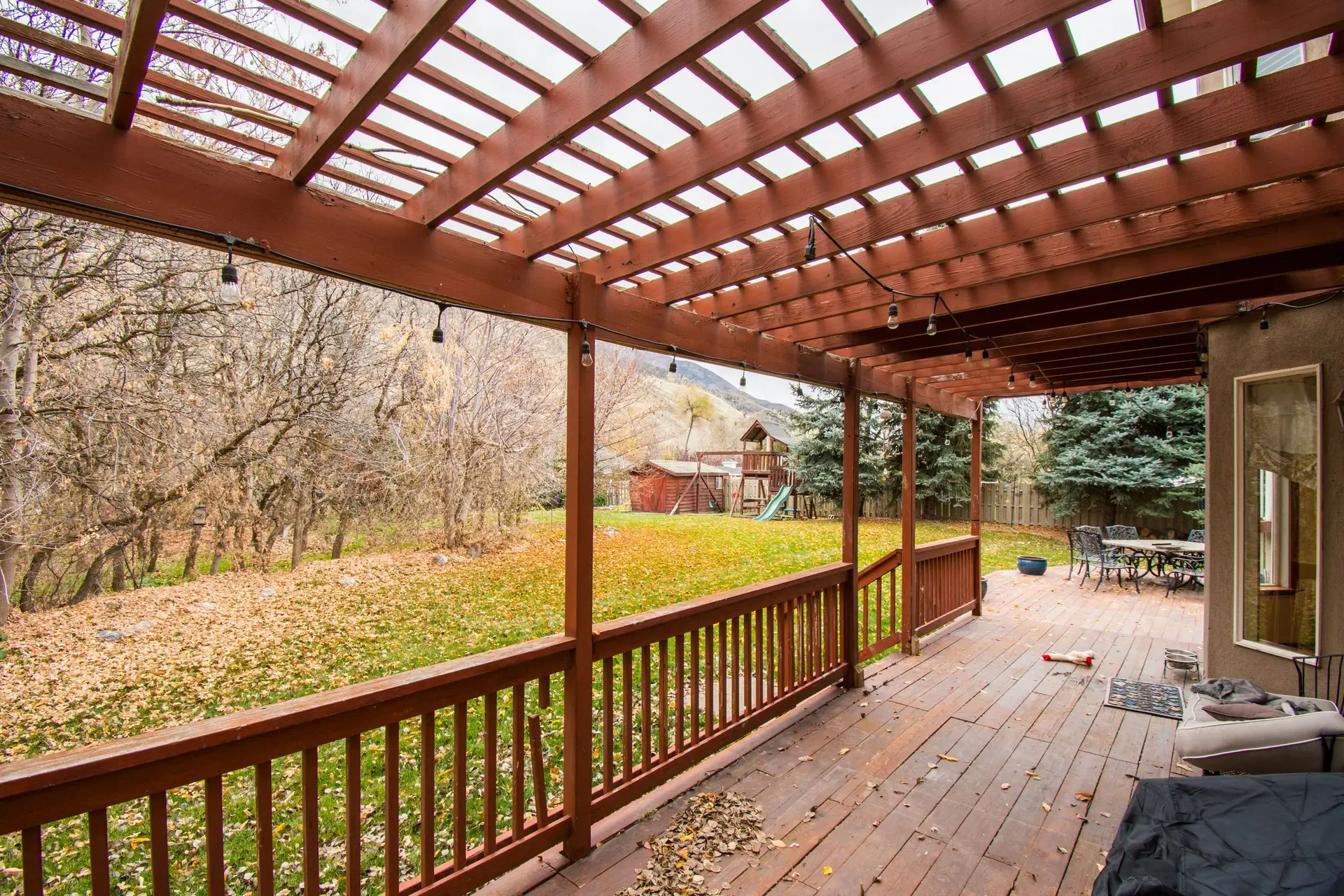
Lomita Decks & Patios in Dense Hardwood
Lomita decks in dense tropical hardwood that shrugs off rot, termites and dents, fastened with predrilled stainless screws on a frame sized for its weight.
Dense tropical hardwood such as ipe is the decking we put first on a Lomita estimate. Its tight grain gives rot and termites very little to feed on, and the surface resists dents from chair legs and dropped tools. Hard sun and dry wind turn bare boards a soft silver and can open fine surface checks, so cut ends are sealed and an oil finish is offered. Where the back door sits well above a lower yard, those heavy boards load a raised frame harder.
Working a very hard board
Ipe is too dense for a nail or an unbored screw, so each fastener hole is predrilled and countersunk. The screws are stainless, because tannin in the wood reacts with plain steel and leaves black streaks around the heads. Hidden clips set into grooved board edges are a second way to fasten it, with a clean face as the result. The board is stiff across a span, so ordinary joist spacing works. Its weight runs close to double that of softwood decking, a figure the engineer adds to the dead load when sizing beams and footings. Sealer goes on every saw cut the day it is made.
Color, upkeep and what holds it up
Left bare, the hardwood weathers to silver and stays sound. Keeping the brown tone means a cleaning and a fresh oil coat whenever it starts to fade, a short job with a brush and a rag. Under the boards, the frame is treated lumber, rated for ground contact wherever it sits close to soil, with butyl tape over each joist top. If the grade drops toward the rear fence, the low posts get taller and are braced in both directions, and the engineer decides whether their footings become drilled piers. A patio at the foot of the stair can pick up the deck tone with tinted concrete.
Decks & Patios in Lomita: questions
Heavy hardwood adds dead load, so the engineer counts it when each footing is sized against the soil findings. On level ground, a Lomita footing has to reach undisturbed soil at least as deep as the code minimum. On a lot with real fall, posts on the low side bear on drilled piers kept a distance from the grade's face that the engineer sets, and each hole is inspected open.
We look the Lomita address up on the state fire hazard severity maps before naming a board. Off the maps, hardwood, composite and treated wood all meet the ordinary deck code. A mapped parcel would need decking with an ember exposure listing, which only some hardwood products carry, so that listing would settle the board and the treatment of the space under the frame.
Both, along with the board itself, since hardwood costs more per foot than treated wood and takes longer to lay with predrilled screws. Height adds posts, bracing and deeper footings. Area adds joists, decking and guard. The quote gives the board a line of its own, so a composite or treated surface on the same frame can be compared side by side.
Decks & Patios in other cities
More work in Lomita
Planning work in Lomita?
Tell us about the lot and the job. A builder replies by phone or email to set up a visit.